Be ready when the album drops on Friday: https://eddiebowles.hearnow.com/
Monday, 28 February 2022
Friday, 18 February 2022
An Interview with Larry Baker
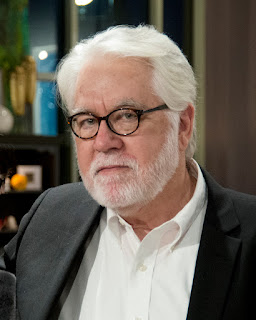
Larry Baker returns to the Final Thursday Reading Series as the February featured reader. Baker is the author of seven novels, including his latest, Wyman and the Florida Knights (Ice Cube Press). A former member of the Iowa City Council, he is also an honoree on the Iowa Literary Walk of Fame in Iowa City.
This month’s Final Thursday Reading Series takes place on February 24 at the Hearst Center for the Arts. The in-person open mic starts at 7 p.m. Baker’s featured reading starts at 7:30. The featured reading can also be streamed live on Zoom. Click HERE for a link.
This interview was conducted by Hannah McConkey.
Hannah McConkey: A number of your books—A Good Man, The Flamingo Rising, Love and Other Delusions, and now Wyman and the Florida Knights—are set in Florida. Aside from it being a good place to visit during long Iowa winters, what draws you back to writing about that state?
Larry Baker: I lived in Florida for three years, enough time to accumulate a ton of material for fiction. It’s a unique state. In the early 1800’s it was the least “American” of all the other states. Part of that was its Spanish background, but the single most important distinction was its natural environment. No other state in the Union was comparable. Today, science and capitalism have destroyed that original environment. Today, Florida might be the “most American” state, a hot mess, the worst of what America is becoming.
In the first few pages of Wyman, Thomas Knight goes to Florida in 1866 to establish his New Church of God. Taken into the interior, led by a black Egyptian guide named Pythagoras Jones, Knight confronts foliage and animals totally alien to his northern experience. Knight thinks in Biblical terms, comparing the land around him to a garden. Jones corrects him. Florida, he says, is not a garden. It is a jungle. Confusing the two can be fatal. And that was the core of my story: human vanity thinking it can cultivate a Edenic garden when in reality it is in a hostile jungle. The beasts in that jungle, literal and metaphorical, are not subservient to men like Knight. They were there first and will not relinquish their own dominion. A hundred and fifty years after Thomas Knight went to Florida, his descendant Norton Knight is a dying man with dark secrets. He asks the artist Peter Wyman to paint his portrait. The result is a portrait that puts Knight back into the jungle that his ancestors first encountered. With the “jungle” as a literal and psychological theme (thanks to Henry James for some influence here too), the Florida of 2016 is the perfect setting. Politics, family dynamics, law and order…all are a jungle. You either adapt and survive, or you die.
HM: Setting is a huge part of Wyman and the Florida Knights. Why did you place so much importance on it, and why did you choose this town in Florida specifically?
LB: Answer above might cover most of this, but the important thing to remember is that I did not “choose” the town. I created it. You might also go back and consider two other fictional towns in American culture—the towns of Sheriff Andy Taylor and lawyer Atticus Finch: two versions of mythical rural America. Knightville is neither, but each shapes a character’s perceptions in Wyman.
HM: With each new character you introduce, you discuss their morality and belief systems. This was an interesting approach. Why did you choose to focus so much on this element of your characters?
LB: If I can say that I have any strength as a writer, it would be shown in the characters I create. As in Wyman, all people are individuals with their own histories and baggage, but a “story,” just like life itself, requires that individuals interact with other individuals…morals and beliefs meshing or clashing—that is the narrative plot—an old Greek truism—“Character is Fate”—each of these character's internal “character” determines their actions—and actions have consequences—In the end, who comes through that final door (last page of Wyman) of your life is a consequence of your character.
HM: Throughout the book, you comment on topics such as racial relations, sexuality, and violence towards women. Did you discuss these topics in order to get more into the different characters’ moralities and mindsets, or was there another reason for this?
LB: Race and sex have always been elements/themes in my novels. Wyman is just much more overt in how I illustrate them. And those are not issues external to, or separate from, a character or a real person. They shape us, black and white, male and female. Unless those issues are embodied in the life of a person, they do not exist. They are merely textbook subjects. The issue of “violence toward women” is much more complicated in Wyman. A husband murders his wife. The wife killed her sister. A man slaps his wife, but then slaps another woman who makes it clear that if he does it again he will be a dead man. Indeed, for me, the two most interesting characters in the story are two very different women, each equally strong and independent in her own way. And, remember, any violence against a woman in the story is eventually punished.
HM: Wyman and the Florida Knights is your seventh novel, which is an impressive achievement. What are you working on now?
LB: A ghost story, seriously. An old taxi driver is lured into a haunted theatre and meets the ghosts of whomever performed on that stage in the past. They are all trapped there in some sort of entertainment limbo/purgatory. He doesn’t know it, but he himself might be the key they need to be finally set free. The ghosts also offer him the only chance to be re-united with the lost great love of his life. So, imagine Marilyn Monroe, Will Rogers, Harry Houdini, Patsy Cline, Mark Twain, et al, being major characters.

Friday, 21 January 2022
An Interview with Kamyar Enshayan
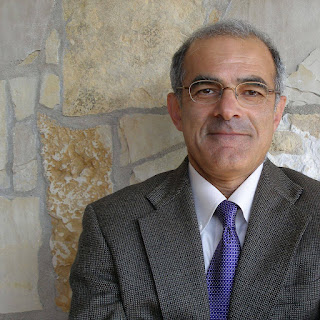
Kamyar Enshayan will be the featured reader at the Final Thursday Reading Series on January 27 at the Hearst Center for the Arts. The in-person open mic starts at 7 p.m. Enshayan’s featured reading starts at 7:30. The featured reading can also be streamed live on Zoom. Click HERE for a link.
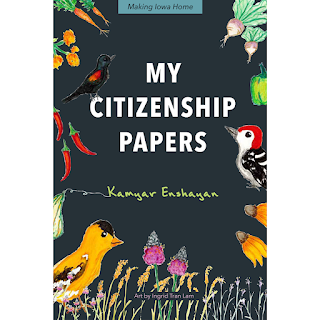
Enshayan was born in Iran and came to the U.S. in 1978. He has worked to strengthen Iowa’s local food economy, directs UNI’s Center for Energy & Environmental Education, and has served on the Cedar Falls City Council. That varied experience serves as the backdrop for his latest collection of essays, My Citizenship Papers.
This interview was conducted by Jim O’Loughlin.
Jim O’Loughlin: The essays, articles and speeches in My Citizenship Papers were written over many years to address a range of immediate concerns. What made you decide to put them all together in a book?
Kamyar Enshayan: I had been thinking about how to celebrate 40 years of living in the U.S., most of it in Iowa. And I wanted to do something to honor these years, the way I have been engaged, what I have learned, people who have been influential in who I have become. So the idea of putting a variety of short pieces together was one way; I also decided to go visit the teacher who taught me English in Hattiesburg, Mississippi 40 years ago.
JO: This book was a project you did with the Youth Art Team. Can you say a little about their work and how you became involved with the organization?
KE: I have been admiring the work of the Youth Art Team for years. Through engaging the youth in the life and history of the local community in creative ways, the Youth Art Team is helping a generation appreciate and develop affection for the place they are growing up, learn who is who and what has happened here, and shape its future. That's the heart of education, and the heart of citizenship. The theme of Making Iowa Home grew out of collaboration with the Youth Art Team, and the young artists interviewed "new Iowans" in the community and learned about their life lessons. This resulted in two short books, one written and illustrated by the Youth Art Team, and the other a series of short articles by me, illustrated by a friend, also a youth artist. 100% of proceeds from the sale of the books support the work of the Youth Art Team.
JO: I appreciate the care you use to find the right metaphors and narratives to communicate scientific concepts. Is that something you consciously try to do when writing for a general audience?
KE: Yes, scientists and engineers have a duty to translate what we know about how the world works in plain English, so that ordinary citizens can weigh in and expect that public officials make decisions based on evidence for the public interest. A strong democracy depends on making decisions in the public interest that are based on evidence rather than purchased political friendship.
JO: While there are many reasons to be concerned about the state of the environment in Iowa and beyond. I’ve always been impressed by your optimistic approach. What gives you the most hope for tackling the challenges we have?
KE: The work of people before us inspires me: people whose sacrifices have brought us our civil rights, our right to vote, laws protecting air and water. My students and my co-workers inspire me; they want to see action, they want to see knowledge acted on, effective and equitable policies implemented. That energizes my work. They say that we already know most of what we need to know to act to solve major problems. I totally agree. Let's get busy.
Monday, 17 January 2022
FTRS Back for 2022
The Final Thursday Reading Series returns for 2022 on Thursday, January 27 with Kamyar Enshayan, an author and activist who currently directs the Center for Energy and Environmental Education at the University of Northern Iowa. Come to the Hearst at 7:00 pm for a live open mic preceding the featured reading, which happens both live and online at 7:30. Click HERE for a Zoom link for Kamyar Enshayan's reading.
Tuesday, 23 November 2021
Pushcart Prize Nomination
Among the very few perks of being a small press publisher is that I get to make Pushcart nominations from the books I publish. This year, I'm pleased to nominate Robyn Groth's "The Magnificent Marjorie Nuhn" from Passion for Beauty: Marjorie Nuhn, Water Colorist.
Friday, 12 November 2021
An Interview with Gary Kelley
Gary Kelley is an artist and illustrator who has recently published his first graphic novel, The Moon of the Snow-Blind (Ice Cube Press) about the event known as the 1857 Spirit Lake massacre. Kelley will be the featured reader at the Final Thursday Reading Series on November 18 (**one week early due to Thanksgiving) at the Hearst Center for the Arts. The in-person event starts off with a creative writing open mic at 7:00. Gary Kelley takes the stage at 7:30. The 7:30 featured reading will also be live Zoomcast. Click HERE to register for the live Zoomcast.
This interview was conducted by Alexus Williams.
Alexus Williams: What inspired you to write this graphic novel? How did you decide to turn this story into a graphic novel rather than a conventional novel?
Gary Kelley: I grew up with that story and mostly in Algona, Iowa. So I grew up hearing about the story of Spirit Lake and Iowa history. Then there’s my uncle who taught me how to draw and was an art student in Minneapolis. He also had a lot of books on his shelves, and that’s where I found Abby Gardner’s autobiography. I also lived close enough to the Iowa great lakes and, the older I got, the more time I got to spend with family or buddies there. I always loved to get into the history, and I had been around all that stuff since I was a kid. Another thing, the same band of Dakotas as Inkpaduta, actually confronted some settlers in the town I grew up in, in Algona. That gave me even more interest in a story like that. Also, I am addicted to Native American history and Native American culture…that’s why I put that quote about there being two sides to every story in the beginning of the novel, we don’t always get their side of the story.
AW: Could you talk a bit about the title of the book? Does “snow-blind” refer to a person or people? Or is there more to it than that?
GK: The title came because I was so into Indian history, especially the Plains Indians. I read a couple of books on this story, and they’re usually titled The Spirit Lake Massacre, totally demeaning the Dakotas, but I wanted to show that there are two sides to every story. So, when I was doing some research on the Sioux Indians, I found they had their own titles or descriptions for every month. When I started going through the Sioux Indians and saw that the month of March is the “moon of the snow-blind” (moon of the = month of the, and snow-blind = March, so the title means “month of March”). I just thought that title was a little more interesting than "Spirit Lake Massacre." I wanted to remind people that they had culture too, so I didn’t want mine to have the same title. However, I did think it was important to have “spirit lake” in the “o” in the title on the book’s cover though.
AW: Having read the graphic novel, I noticed that everything is in black and white, is there a reason why you chose to have the story printed as such? If you did not have a choice in the matter (due to publishing costs), would you have chosen to print in color? Do you think color impacts the story?
GK: I definitely thought about that, but I haven’t been asked that before. First of all, I like to draw. I like to draw in black and white, composing in darks and light that black and white will give you. Number two, it would have cost the publisher a lot more money to print 175 of the 180 pages with a lot of colors or full colors. I didn’t think the colors in a story like that meant a lot to justify having them printed in color. I worked on that story off and on and worked on it for a lot of years. A lot of things are intriguing in black and white too—more clean and linear. I would guess that if that were a full color book, it would have to cost another 10 or 15 dollars. I’ve got another one (book) in the works with the same publisher right now, and I keep thinking, “well it would be fun to introduce color into part of the story…” Also, black and white composition, to me—whether it’s that book, or one of the ones in the works now—what really gets me into those stories and telling them visually is that I love to be able to read and see how the images match up and how they embrace the words or prepare you for the words on the next page.
AW: Do you see yourself creating more graphic novels that tell historical narratives? Do you plan on focusing on Iowa history if you do?
GK: If I was going into Native American history outside of Spirit Lake, I don’t know what I would do. The one I just finished, that’s at the publisher now, has nothing to do with Iowa or Indians or that history. It’s a story I heard on NPR, I heard it the night before Thanksgiving six or eight years ago, and I never forgot it. It was about two famous musicians (Robert Johnson, a blues master from the 30s, and Pablo Casals, a famous cello master from Spain), what really sparked me is that they had these really famous albums recorded the same week in history. I remember NPR talking about how the two musicians never knew each other. I thought it was a terrific idea because those two guys were classic musicians with no connections, but they had these great albums recorded at the same time. I saw this really great biography on Pablo Casals about what he had to deal with in Europe –with Hitler and Mussolini and how that affected him because Hitler hated him. Casals had to be careful to avoid a lot of things that were happening then…and I thought, “jeez, that was really interesting.” The book is titled, Bach and Blues. They (Johnson and Casals) had such dramatic life stories, and each one was so famous in their music and their careers. They had no idea who each other were, but they both recorded their most famous albums the same week in history (third week of November 1936). It’s at the publisher now, and I hope it’ll be out in May. The Waterloo-Cedar Falls Symphony will be doing a concert on that story in May and will have a cello and guitar on the stage. Also, Robert Johnson had to deal with racism down south in the 1930s. It was terrible growing up there and building a career. And Pablo Casals was in Europe, and he hated the Nazis and their culture and Hitler. All of this really made me think this would be a fun story to tell and a good concert–I think it’s only going to be 64 pages rather than almost 200 pages like Moon of the Snow-Blind.
AW: Did you think Moon of the Snow-Blind was going to be as long a story as it turned out to be?
GK: It’s the length it is because of the way I like to tell stories visually and how they match up or support the words on the pages–or how the words support the pictures. I try to make each page interesting to look at, from a point-of-view of each picture and doing my homework, doing my research. Or I find a story like that where I can use a lot of interesting visuals. It lets me go back to how my career started– as an illustrator. So, when I do my book, I can do 180 pages of that, which is really fun.
Thursday, 11 November 2021
Maribeth Boelts Zoomcast
If you didn't get a chance to see Maribeth Boelts's Final Thursday Reading Series presentation, the Zoomcast is now available for streaming.
Subscribe to:
Posts (Atom)